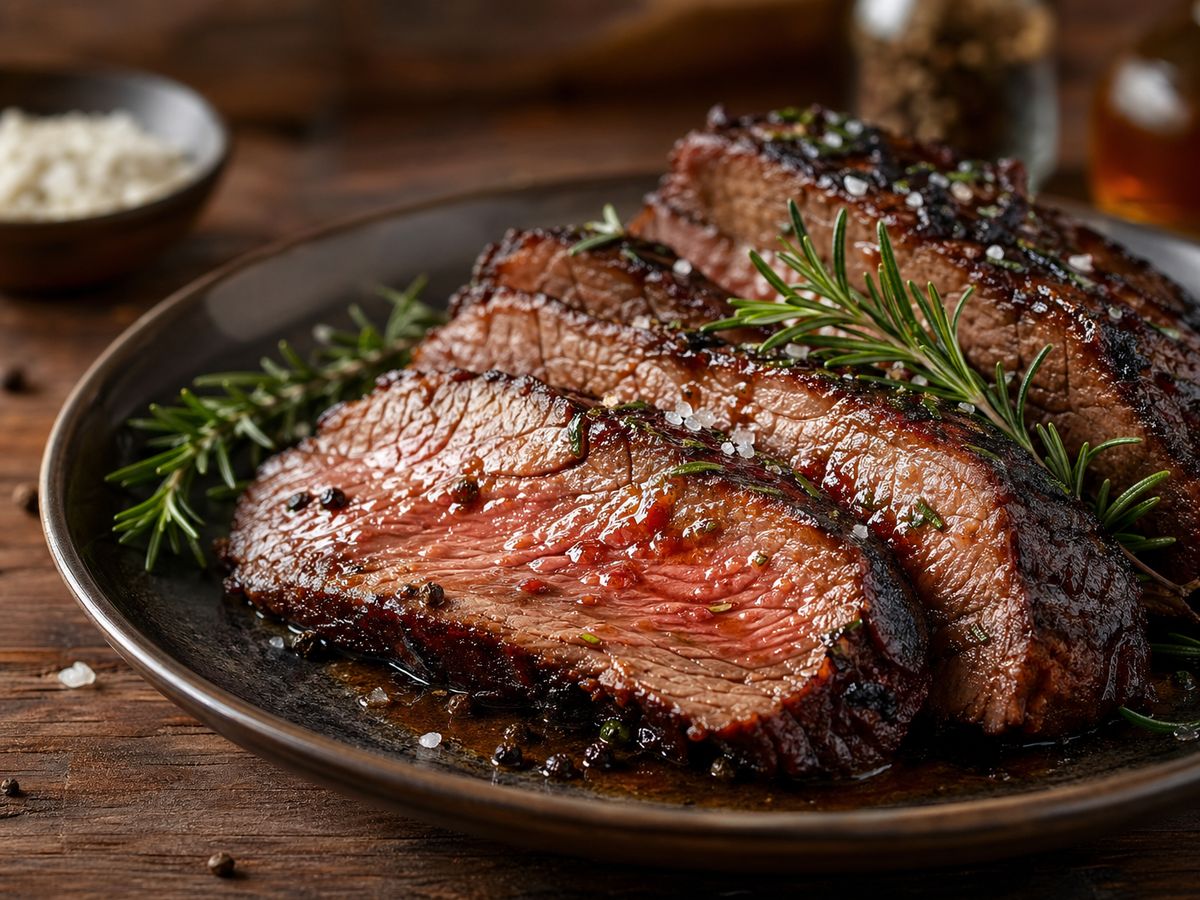
Prime rib has one job: a deep brown crust on the outside, and a rosy, even pink all the way to the center — not a gray ring of overcooked meat surrounding a small pink bullseye. Getting that result consistently comes down to flipping the usual cooking order on its head.
1. Cook low first, sear last
Most people roast at a high, constant temperature and hope for the best. We do the opposite: a long, slow roast in a low oven until the roast is just a few degrees short of your target temperature, followed by a short, blazing-hot sear at the very end. Cooking low and slow first means the heat has time to travel gently to the center without overcooking the outer layers along the way — which is exactly what produces that edge-to-edge pink you want, rather than a thick band of gray "well-done" meat under the crust.
2. Let the sear do the crust's job, not the oven
Because the interior is already at temperature after the slow roast, the final hot sear only needs a few minutes — just long enough for a deep, dark, crackling crust to form on the surface. The inside barely moves. This is the opposite of a traditional high-heat roast, where the crust and the doneness fight each other the entire time the meat is in the oven.
3. Pull it before you think you should
Because the roast is coasting on residual heat during that final sear (and again during the rest that follows), pull it a few degrees before your actual target internal temperature. Carryover cooking will close the gap on its own. Pulling "in time" instead of "just in time" is the single most common reason a reverse-seared roast overshoots medium and lands closer to medium-well.
The reverse sear takes patience, not skill — it's a method built around giving the process the time it actually needs, in the right order.
From Our Kitchen
We already reverse-seared it
Our prime rib is roasted low and seared hot, then delivered fresh every Friday — no oven required.
Order This Week's Prime Rib